




How Can Harvesting Nets Reduce Fruit Loss and Labor Costs in Commercial Orchards?
Release time: 2026-10-30
Table of Contents
Why Fruit Collection Efficiency Matters in Commercial Orchards
Harvesting efficiency has a direct impact on the operating costs and profitability of commercial orchards. During peak harvest periods, large quantities of fruit must be collected within a limited time. If the collection process depends heavily on manual picking from the ground, labor requirements can increase significantly, especially across large planting areas.
Fruit loss is another important concern. Apples, olives, cashew nuts, and other agricultural products may fall during natural ripening or mechanical harvesting. When they land directly on hard, uneven, or contaminated ground, they can suffer bruising, surface damage, or quality deterioration. Some fruits may also become difficult to locate among grass, leaves, and soil.
Harvesting nets provide a practical way to improve this process. Installed beneath tree canopies or across designated collection areas, they create a surface that catches falling produce and makes subsequent gathering easier.
For commercial growers, the benefits are not limited to preventing fruit damage. Properly selected nets can simplify collection, reduce repeated manual handling, and improve the organization of harvesting operations.
How Harvesting Nets Reduce Fruit Loss and Labor Costs
The value of a harvesting net depends largely on how well it fits the orchard’s harvesting method and ground layout.
Protecting Fruits from Direct Ground Contact
One of the main functions of a harvesting net is to provide a softer collection surface between falling fruit and the ground.
When olives, apples, or nuts fall directly onto hard soil, stones, or other rough surfaces, impact damage can affect their appearance and quality. This is particularly important for fruits intended for fresh markets, where visible bruising and surface defects may reduce their commercial value.
A properly positioned net catches falling produce before it reaches the ground. It can also help keep harvested fruits away from mud, grass, and some ground debris.
The level of protection depends on the net’s material, mesh construction, tension, and distance from the ground. Buyers should therefore evaluate the actual product design rather than assuming that every agricultural mesh provides the same level of impact protection.
Directing Fallen Fruits to Collection Points
Harvesting nets can also improve how fruits are gathered.
In traditional orchard operations, workers may need to search around individual trees and collect produce scattered across the ground. This creates additional walking, bending, and handling time.
By spreading nets beneath tree canopies, fallen fruits can be gathered within a more defined collection area. Depending on the orchard layout, nets can be arranged to direct produce toward accessible gathering points.
For olive harvesting, for example, nets can be spread beneath tree branches before shaking or other harvesting operations begin. After the olives fall, workers can bring the net edges together or gather the collected produce using a suitable handling method.
For apple orchards, the use of nets depends on the harvesting system and whether fruit is intentionally collected after falling. Since apples can bruise under impact, net placement and material suitability are particularly important.
The objective is to reduce the distance between the point where fruit falls and the point where it is collected.
Reducing Manual Collection Time
Labor costs are not determined only by the number of workers employed. The time required to complete each harvesting task also matters.
Without collection nets, workers may spend considerable time searching for scattered produce, separating fruit from leaves and soil, and transferring it into containers.
With a well-organized net system, a larger quantity of produce can be collected within a defined area. Workers can focus more on gathering, transferring, and sorting instead of repeatedly searching the orchard floor.
This can be especially useful for large orchards where the same harvesting process must be repeated across hundreds or thousands of trees.
However, the actual labor savings depend on tree spacing, terrain, harvesting equipment, net dimensions, and the number of workers involved. Nets should be selected as part of the overall collection workflow rather than treated as a standalone solution.
Supporting More Consistent Harvesting Operations
Commercial orchards often need to coordinate harvesting schedules with transportation, temporary storage, sorting, and processing.
When fallen fruits are scattered over large areas, collecting and transferring them can become difficult to organize. Harvesting nets help create more predictable collection zones, making it easier to plan the movement of workers and harvested produce.
For orchards using mechanical tree shakers, nets can be positioned in advance to collect the falling fruit. This helps connect the shaking process with subsequent gathering and transfer operations.
A consistent collection layout also makes it easier to estimate the required number of nets, collection containers, and workers for each harvesting section.
What Performance Features Should Orchard Harvesting Nets Have?
Not all agricultural nets are suitable for fruit collection. Buyers should pay particular attention to the following characteristics when comparing products.
Mesh Strength and Load-Bearing Capacity
A harvesting net must withstand the weight of collected produce, repeated handling, and the tension generated during installation and retrieval.
Mesh strength is influenced by several factors:
- Material type and raw material quality
- Yarn thickness and weaving construction
- Mesh size and overall fabric density
- Edge reinforcement and stitching
- Net dimensions and distribution of collected weight
For orchards harvesting heavier fruits or handling large quantities in one collection cycle, insufficient mesh strength may lead to excessive stretching, deformation, or tearing.
However, stronger and heavier construction is not always better. An unnecessarily heavy net can increase handling difficulty and labor requirements.
The appropriate design should balance load capacity, flexibility, weight, and ease of operation.
UV Resistance and Outdoor Durability
Harvesting nets are frequently exposed to direct sunlight, changing temperatures, moisture, and outdoor storage conditions.
UV exposure is particularly important because prolonged sunlight can gradually weaken plastic materials, reducing tensile strength and flexibility.
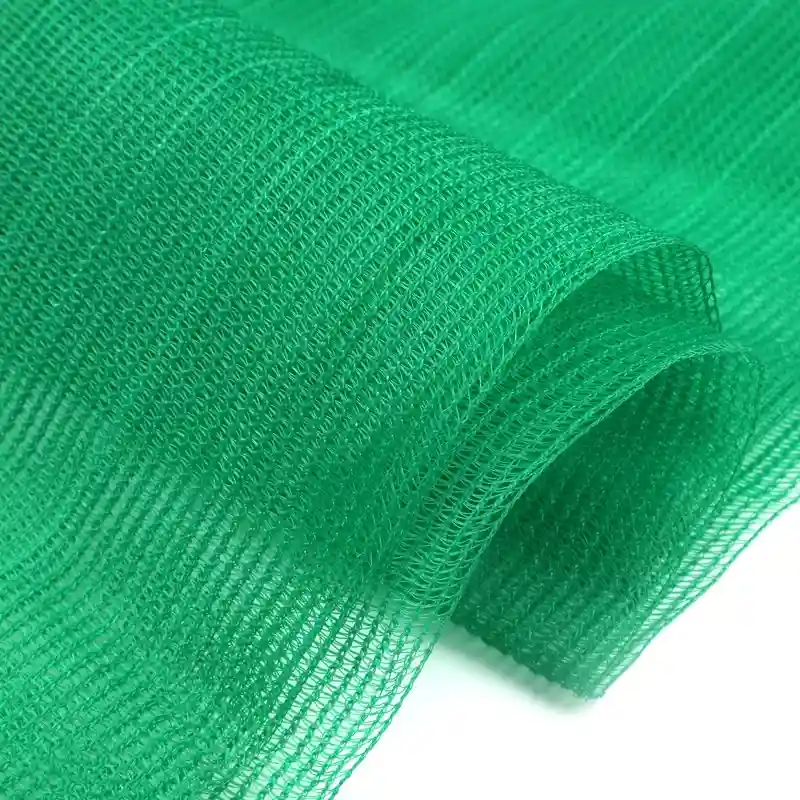
A UV-resistant HDPE mesh is a practical option for agricultural applications requiring outdoor exposure and repeated use. HDPE offers a combination of relatively low weight, flexibility, and resistance to moisture.
When comparing products, buyers should ask about UV stabilization, material composition, tensile properties, and expected service conditions.
It is also important to distinguish between resistance to sunlight and resistance to mechanical damage. Even a UV-stabilized net can be damaged by sharp branches, stones, machinery, or improper handling.
Mesh Design and Fruit Collection Efficiency
Mesh size affects both collection performance and product suitability.
If the openings are too large, smaller fruits or nuts may pass through. If the mesh is too dense, it may retain more leaves, twigs, and other debris, increasing cleaning time.
The appropriate mesh structure depends on the produce being harvested.
For olives and cashew nuts, the openings should be suitable for catching the target produce without allowing excessive loss through the mesh. For apples and other larger fruits, the mesh structure should also be evaluated for surface contact and impact protection.
Net dimensions are equally important. A net that is too small may leave areas beneath the canopy uncovered, while an oversized net can become difficult to position and retrieve.
For orchards with different tree sizes or planting layouts, customized dimensions may help improve coverage and handling efficiency.
Easy Handling, Cleaning, and Storage
Harvesting nets are often moved, folded, unfolded, cleaned, and reused throughout the harvest season.
A practical design should be manageable for the available workforce and compatible with the orchard’s collection equipment.
Before purchasing, consider:
- Whether the net can be folded and transported conveniently.
- Whether the edges are reinforced for repeated pulling and lifting.
- Whether the material can be cleaned easily after contact with soil, leaves, and fruit residues.
- Whether the net dries within a reasonable period after washing.
- Whether it can be stored without excessive creasing or damage.
After harvesting, remove branches, leaves, and remaining fruit residues. Clean the net according to the material manufacturer’s instructions, allow it to dry thoroughly, and store it in a dry area away from sharp objects and prolonged unnecessary sunlight.
Regular inspection of seams, edges, and mesh openings can also help identify damage before the next harvesting cycle.
Choosing Harvesting Nets for Different Orchard Crops
Different crops have different harvesting characteristics. A suitable collection net should match the fruit size, falling behavior, harvesting equipment, and intended use.
| Orchard Crop | Common Harvesting Method | Key Net Requirements | Main Considerations |
|---|---|---|---|
| Olives | Manual picking, branch shaking, or mechanical tree shaking | Flexible, durable mesh with suitable coverage and openings | Efficient collection beneath the canopy and easy gathering |
| Apples | Manual picking or controlled fruit collection | Appropriate surface construction, strength, and suitable dimensions | Reducing impact damage and preventing unnecessary bruising |
| Cashew nuts | Natural falling and manual collection | Mesh openings suitable for smaller produce and good outdoor durability | Preventing nuts from becoming mixed with soil and debris |
| Other orchard fruits | Depends on crop and maturity | Crop-specific mesh size and load capacity | Fruit size, weight, impact sensitivity, and harvesting workflow |
Olive orchards: Olive harvesting nets are commonly spread beneath tree canopies before manual or mechanical harvesting. Their primary role is to catch falling olives and make collection easier. Flexibility, UV resistance, and reinforced edges are particularly useful when nets need to be repositioned frequently.
Apple orchards: Apples require greater attention to impact protection because bruising can affect their marketability. Net material, installation height, tension, and the method by which fruit reaches the net should all be considered. A harvesting net should not be assumed to replace careful picking or dedicated fruit-catching equipment where fresh-market quality is required.
Cashew orchards: Cashew nuts are relatively small compared with apples and many other orchard fruits. Mesh openings should therefore be selected carefully to prevent produce from passing through. Easy cleaning is also important because nuts collected from orchard floors may be mixed with leaves, soil, and other debris.
For mixed-crop operations, buyers should avoid assuming that one mesh specification will work equally well for every crop. Different net sizes or constructions may be more practical for separate harvesting areas.
What Specifications Should Buyers Confirm Before Bulk Purchasing?
For distributors, agricultural equipment suppliers, and large orchard operators, bulk purchasing requires more than confirming the product name and unit price.
The following specifications should be discussed before placing an order.
1. Material and UV protection
Confirm whether the net is made from HDPE or another material. Ask about UV stabilization and the intended outdoor application.
2. Mesh size and construction
Specify mesh openings, yarn thickness, fabric construction, and any reinforcement requirements. These details are especially important when collecting smaller produce such as olives and cashew nuts.
3. Net dimensions and coverage
Provide the required width and length, together with the approximate area to be covered. For large orchards, estimate the number of nets required per tree or harvesting section.
4. Strength and handling requirements
Discuss tensile strength, edge reinforcement, expected loading conditions, and whether the nets will be pulled manually or handled with equipment.
5. Color and customization
Confirm available colors, dimensions, packaging, labeling, and other project-specific requirements. For distributors, consistent specifications across multiple production batches are particularly important.
6. Sample testing and quality consistency
Request samples before bulk ordering. Test the net under actual orchard conditions to evaluate flexibility, fruit retention, cleaning convenience, and resistance to repeated handling.
7. Packaging and delivery arrangements
Confirm roll or folded packaging, quantities per package, minimum order quantity, production lead time, and shipping arrangements. These factors can influence inventory planning and the final landed cost.
Working with a reliable harvest collection net supplier can help buyers coordinate product specifications with different orchard applications. Rather than comparing quotations based only on price per square meter, evaluate material quality, construction consistency, customization capabilities, and suitability for the intended harvesting method.
Frequently Asked Questions
1. Can harvesting nets be reused for multiple harvest seasons?
Yes, provided the nets are manufactured with suitable materials and maintained properly. Their actual service life depends on UV exposure, mechanical stress, handling frequency, and storage conditions. Inspect the mesh and reinforced edges after each season and replace damaged sections when necessary.
2. What mesh size is suitable for olive and cashew nut collection?
The mesh openings should be small enough to retain the target produce. Since cashew nuts and olives differ in size and shape, buyers should confirm the actual opening dimensions and test samples before bulk purchasing. Avoid selecting mesh size based solely on general product descriptions.
3. Are harvesting nets suitable for mechanical olive harvesting?
Yes. Nets can be positioned beneath tree canopies to collect olives released by mechanical tree shakers. However, buyers should confirm net dimensions, tensile strength, edge reinforcement, and compatibility with the collection and retrieval process.
4. How should harvesting nets be cleaned and stored after use?
Remove leaves, branches, soil, and fruit residues before cleaning. Follow the manufacturer’s material-specific cleaning recommendations, allow the net to dry, and store it in a clean, dry location. Avoid dragging it over sharp surfaces or leaving it exposed to unnecessary prolonged sunlight during storage.
5. What information should distributors provide when requesting a bulk quotation?
Distributors should specify the target crop, material preference, mesh size, net dimensions, required UV protection, estimated order quantity, packaging requirements, and destination market. Providing these details helps suppliers recommend a more suitable product and prepare a more accurate quotation.
Powerician offers agricultural collection net solutions designed for orchard applications such as olive, apple, and cashew nut harvesting. Its fruit harvest collection net uses UV-resistant HDPE mesh, providing an option for buyers who need lightweight, reusable collection materials for outdoor agricultural operations. When evaluating different specifications, orchard operators and distributors should prioritize mesh performance, dimensions, and handling requirements to ensure the product fits their actual harvesting conditions.